Showing posts with label economics. Show all posts

Sunday, February 14, 2010

Banning the use of the word Sustainable


In a finite world due to be sucked into the sun in only 7.5billion years, nothing is truly sustainable. "Sustainable" has become so meaningless that the local chamber of commerce referred to a "return to a sustainable economy" recently, so would we be lost for words if we banned the use of "Sustainable"?

I'm going to try very hard to remove the word from my vocabulary from now on and use some of these instead:

Resilience - the ability to bounce back, and often the opposite of efficiency. A highly efficient system is designed for the highest gain in the short term. It is tuned to current circumstances and as soon as those circumstances change it is no longer efficient. The more efficient and specialised a system, business or organism becomes the less adaptable and resilient. Resillience is about the boring stuff. The boring banks were more resillient, the boring businesses producing essential goods and services for local markets - funeral directors, tyre sales, food markets are all ticking away. Resillience is about reliability and repairability. Resillience is about having an infrastructure we can trust - energy, transport, broadband, water.

Continuity - the value in keeping some things the same while others change. The loss of a business is not simply a monetary loss for the economy but the loss of intelligence. An established company has an intelligence and learning of it's own which is held by it's staff. While some of that intelligence may be written down, breaking up the people means losing that intelligence. Continuity is about keeping and using that collective intelligence, even if the original purpose has changed.

Balanced Portfolio - In the old days, a couple of decades ago, financial advisors talked about a balanced portfolio. You had your safe (!) bonds and blue chip stocks, your more risky stocks and shares and a few high risk investments. If our economy was a balanced portfolio, the safe investments would be investing in our own elf-sufficiency, making goods and services that are needed in our own economy. The medium risk would be making goods for export markets, attracting multinational FDR and investing in foreign businesses. High risk would be relying on cycles that are likely to be short lived - housing booms have historically been followed by housing busts and there seems to escape from that cycle.

Natural Lifespan - while long term thinking, continuity and resilience have their place, being able to exploit short term opportunities, the high risk element of the balanced portfolio, is also of great benefit and the trick here is to build in the demise as well as the creation and the skill is in knowing when to change.

What all of these words have in common is a longer term view of success than we have become used to, so rather than asking for the speaker's or author's definition of "Sustainable" as I have in the past, I will ask "Do you mean continue indefinitely, or do you have a more realistic timeframe in mind?".

Saturday, December 12, 2009

New Scenarios for Ireland 2025


Scenario Based Planning

Scenario planning is a technique for exploring the future by creating several plausible but challenging alternative futures rather than making a single prediction. It has been used by commercial companies since the 1970s when Shell was the only oil company prepared for the oil shocks of that decade as a result of its use.

Why use Scenario Planning?

A prediction is (almost) never right. The unexpected always happens and the assumptions, conscious and unconscious, that apply today may not apply tomorrow. For example, at the end of the last century, London could see no solution to the ever increasing amounts of horse manure on the roads, then along came the motor car. This highlights the difficulty with using forecasts: they carry forward current trends, problems and constraints and do not allow for the unexpected.

Scenarios are versatile. Scenarios can be used not only to prepare plans for the future, but to check existing plans for robustness. Will a plan work in more than one scenario or will fail if any of the underlying assumptions change? If we can develop flexible plans that will work with multiple scenarios, then, when the unexpected does happen, there is a better chance that the plan can be adapted to the new circumstances.

It is difficult to get consensus for a prediction. You can either agree or disagree with other people's predictions - and the tendency is to disagree. Scenario planning is about building plausible futures, a much less contentious task because we only need to agree that a scenario is possible to be able to use it. We don't even have to agree that it is likely.

Good scenarios challenge one's thinking and stimulate discussion. The human species has spent most of its history telling stories rather than looking at graphs and spreadsheets. As a result, the implications of a rich story about the future can be more easily understood and used. It is surprising how much information a scenario can convey in a few words. For example, the following classified advertisement can tell us a lot about what the future might be like under a particular scenario:

For Sale: 4x4 with axle suitable for conversion to wind turbine.

This can be interpreted as: Increases in the price of transport fuel have meant that vehicles with high fuel consumption are no longer in demand and it is becoming difficult to sell these vehicles. However, with increasing prices of home electricity, there is a boom in DIY windmills. A component of these windmills is the back axle of a car.


The original Energy Scenarios Ireland, originally described in 2006/7 have been updated, though in a many ways they have not fundamentally changed.

Business As Usual has become Celtic Kitten - our focus is to get back to 'normal' but without a property boom to support the economy and a mountain of debt to support, it's a bit of a disappointment.

Enlightened Transition has become Celtic Phoenix - rather than emulate the ambitions of others, Ireland plays to the talents we have. A well educated work force, adaptable and creative, a small country with plentiful renewables - just what is needed to build and trial new products and services. Ireland markets itself as a big hothouse for new and growing young businesses.

Enforced Localisation has become Celtic Hedgehog - Back to the land and a life of frugal comfort. It takes decades for Ireland to re-emerge.

Fair Shares becomes Celtic Fox - In honor of Colin Campbell who used the Celtic Fox in his presentations. Ireland applies it's abilities to make the best of difficult times to adapt to a high cost economy. Times are tough but we are now well placed to build a stronger economy.


Further installments to follow, with particular focus on Celtic Phoenix.

Wednesday, September 16, 2009

How much is €60bn?

If we are trying to solve our economic problems and we have €60b to spend, what could we buy?

Three of these: $21 BILLION ORBITING SOLAR ARRAY WILL BEAM ELECTRICITY TO EARTH - http://www.physorg.com/news172224356.html, which would add 50% to our generating capacity

All the top racehorse stallions in the world - really corner the market!

A load of overvalued properties

or

A lot of oil futures - just sit back and relax and watch the money come it!

Thursday, September 10, 2009

Thoughts on NAMA

When the main reason we are being given for NAMA is that it is the only game in town you know this is not a good idea. I did a bit of googling and chatting to various people who know more than me about these things, and reached these conclusions:

The reason for considering NAMA is to:
- Maintain Liquidity
- Restore Confidence
- Create an environment for recovery

Any solution must consider:

1. When given a choice we must choose to reduce risk rather than increase potential return - the government/taxpayers are not speculators
2. No plan can be justified on the basis of previous economic cycles - we are in uncharted waters with this global economic downturn and the impact of peak oil and spending on climate change not yet being felt.
3. The current banking model is not the only solution to maintain liquidity - banks can be bought out, new banks setup by entrepreneurs, new methods of lending and saving peer to peer etc.
4. No solution should have the objective of punishing or protecting individuals or companies.
5. Speculators have money but little time (they want a quick buck now), the government of a country has time but no money - any solution should play to our strengths.
6. Ireland has a finite amount of money it can borrow and spend over the next years - the opportunity cost of any solution must be compared against investing in projects which will support our economy in the future - energy, broadband, transport, food etc.

Risks
- What happens if, post NAMA, the banks are still unable to provide liquidity? Is there a Plan B? "There is still unexploded ordinance on the financial landscape..." FT


Questions
- Banks have already received an injection of cash but are still not lending. Is this a cashflow problem or a reserves problem? If it is a reserves problem, then they can do without cash!
- What would the impact on the economy be if our banks were bought by foreign banks or investors?
- Why do WE have to do the valuation? Take the bad assets on the basis that we will pay the banks the market price when they are liquidated - at some time in the future - and leave the banks to do the valuation for the purposes of their balance sheets?
- Why would nationalising the banks be worse than NAMA? We already own 25% of AIB and BOI at a cost of €7bn, why not buy the rest?


But I think the right questions to ask is, image we have €30-60bn to invest in the future. What are the best investments to relieving short term hardship and creating an environment for long term prosperity?

Liquidity - Buy a foreign bank or start one or support entrepreneurs who want to. Support local trading currencies. Support peer2peer lending.
Energy - building windmills is not enough to protect us from future oil shocks, we need the infrastructure to balance supply and demand of energy.
Transport - our infrastructure is predicated on the use of roads and the assumption that transport of people and goods is cheap.
Food - Ireland should be well placed to feed it's citizens in the event of disruption in trade or climate change disrupting harvests and supply surplus into the UK.
Broadband - without ubiquitous, affordable high speed broadband many options for change are restricted and new ideas are slower to develop.

I am not generally in favour of asking the country to vote, but in this case it's our money (or money we are borrowing and will have to pay back) so I think we should be asked. We will be voting anyway, whether the government is forced to call an election or whether we use the Lisbon vote, we will have our say.

Saturday, November 15, 2008

FT this weekend 15th November 2008

Companies feel chill as trade credit insurance dries up

Companies that provide insurance against bad debts are reducing their cover - in one example from 90% to 60%. Other companies, such as Atradius, are withdrawing cover for whole counties and that list includes Ireland. As Ireland is so keen on leading the way with gaurantees, maybe we could lead the way by guaranteeing payment for all goods and services bought from Ireland?


G20 heads forced to temper ambition

The focus of the article is on how we are likely to regulate the banks in future and a process for introducing new regulations. This feels like closing the door after the horse has bolted. I know at some point in the future the door will need to close, bit isn't the priority to find the horse? Then we need to get a headcollar on him, maybe by tempting him with a bucket of feed, and then we can, hopefully, get him back into the stable...

Doubt cast on funds for Beijing boost

I have been asked all kinds of people over the last few years how dependant on exports they thought China was. If there was a slowdown in the US and Europe, would it significantly effect China. I got unsatisfactory answers, usually along the lines of "I don't know". A few felt China would continue to grow regardlesss of what else happened in the world.

Well to get the full answer, we are going to have to wait. China is still growing but at much lower levels than expected. It would seem that our global economy is so intertwined that nobody is recession proof.


Good Question Ma'am. But some people did see it coming

The Queen asked Luis Garicano of the London School of Economics "If these things were so large, how come everyone missed them?". Well some did, writes Alan Beattie in an entertaining reply to the Queen. "It gets dangerous when you treat economists as court necromancers, listening only to the ones you find congenial".

Monday, November 10, 2008

The Celtic Phoenix

With all the understandable focus on the credit crunch and contracting economy, the interlinked problems of peak oil and climate change have been lost, and they are a big part of the solution. If we are to maintain our current economic model, the government is going to have to pump money into the economy and what better way than with gifts that keep on giving. A new windmill keeps generating revenue year on year, a house whose energy efficiency has been upgraded with double glazing and insulation, not only releases income for alternative spending this year, but next year and the year after. By moving spend from imports, and nearly 90% of our energy is imported, to locally produced energy, this will put money back into the economy. And moving to a sustainable energy infrastructure, which includes generation, distribution, storage and use of energy, will create a wide spectrum of new jobs. from installation of windmills, redesign of products for lower cradle to cradle energy and oil use, software innovation for improving logistics and installing plug in points for electric cars. There is huge potential for new businesses to manufacture wind and wave equipment, manufacture electric cars and increasing cost of transport makes local production more competitive, especially in food production.

Rather than be sidetracked by the possibility of losing advantages over which we have little control, such as incentives for encouraging foreign investment, lets focus on the advantages nobody can take away. Our excellent wind and wave potential, our good agricultural environment, and above all, our ability to adapt very quickly to changing times.

First there was the Celtic Tiger, now there is the Celtic Mouse, but lets awaken the Celtic Phoenix.

Friday, October 17, 2008

Tax As You Go


I hate doing tax returns. In fact if I could pay a bit of extra tax in order not to have to do a tax return I would! So here is a wild idea for making my life easier.

Tax as you go.

I sign up for a deal that adds 5% to every transaction I have with my bank that goes straight into my tax account. If I withdraw €100 from the ATM, €105 is deducted from my bank balance and €5 is added to my tax account. If I pay for €50 of shopping with my credit card, another €2.50 goes into the tax account. At the end of the tax year, the money in my tax account has interest added (which is above the rate I would receive at the bank) and is deducted from my tax bill.

When I pay may tax bill online I get to decide on where 50% of my tax goes and I can allocate it between health, education, public transport etc. There might also be special requests for funding - a hospital wants a new cancer treatment machine - and I can allocate some of my money to that. I can recieve updates on how that funding drive is going by text or email. The government gets to decide on what the pots are - we get decide how much goes in each pot. If we feel passionately that one pot is more deserving than another, WE can lobby our friends to put their allocation in that pot. Once a pot is full, the government MUST proceed with that project. This helps us feel part of the link between paying taxes and getting services which I know is missing for many of us.

There might also be some kind of gold star award we recieve when we pay a certain amount of tax that shows we are a responsible member of the community. People with gold stars are listed, so a wealthy person without a gold star is clearly visible to community and it is clear they are not contributing much to rebuilding the local school etc.

In the long term, I would like a pay as you go system to replace income tax and other forms of tax, removing loopholds and dodgy incentives. When what we want is more jobs and to use resources more efficiently, it makes more sense to me to tax stuff not people. So if I earn lots of money, I don't pay any tax until I spend it. If all transactions, including financial trading, were included, we would only pay a small tax, probably 0.5% on each transaction! Then there would be an end to tax returns - what joy!

Monday, September 22, 2008

Slow Money?

Unpublished (!) letter to the FT

As has been repeatedly observed for longer than this recent crisis, there are systemic problems with the financial markets, one of the these in my view is the increasingly short-term thinking of all concerned. I suggest one solution to this problem would be to put traders bonuses into pension plans that include a mix of shares appropriate to those they are dealing in. This would give a great incentive to ensure markets were not destabalised. Maybe like slow food and slow travel it is time to consider making a slow buck.

Monday, September 15, 2008

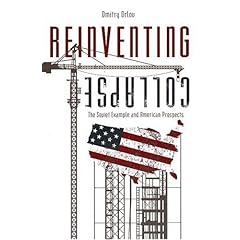
Review of Reinventing Collapse by Dmitry Orlov

I love seeing the world through the eyes of people who look at the world differently from the rest of us - brain candy! Dmitry Orlov has an unusual background and does not take the usual view of how and why the Soviet Union collapsed or that the US economy is sacrosanct.

Dmitry was born and grew up in Russia but settled in the US, returning to Russian regularly during the fall of Communism and so has both an insiders and an outsiders perspective.


The ingredients for the economic collapse of a superpower, as learned from observing the Russian experience:

  • a severe and chronic shortfall in the production of crude oil
  • a severe and worsening trade deficit
  • a runaway military budget
  • ballooning foreign debit
Add to this a humilating military defeat and widespread fear of a looming catastrophe and the result is economic collapse.

In the Soviet Union the defeat in Afghanistan followed by the Chernobyl catastrophe against a backdrop of oil production collapse, foreign trade imbalance and the inability to produce enough food and consumer goods, led to it’s downfall.

Dmitry believes the US is poised to follow suit with oil peaking in the 1970s, trade imbalance, a huge military budget and foreign debit denominated in dollars but held by international creditors. While the US is theoretically self-sufficient in food, inputs of 10 calories of energy for each 1 calorie of food produced mean that loss of imports would lead to loss of food supply.

You will have to read the book to fully explore the arguments put forward, but they certainly give me pause for thought and I will be exploring the consequences more fully as part of the Localisation scenario that forms part of the Energy Scenarios for Ireland.

As oil supplies decrease in the US, Dmitry argues "less is produced, but the amount of money in cirulation remains the same, causing the prices for the now scarcer products to be bid up, causing inflation". I do believe (hope!) that Dmitry is overly pessimistic about the way in which people and businesses will respond to increasing energy prices and other finite resources. Given that we waste huge amounts of energy because it has not be cost effective to do otherwise, and we have grown lazy because of the low cost of energy, there is huge potential for reducing demand. I have a figure of 50% of the energy we use does not deliver useful work - for example, the heat your car engine produces, or the energy used in standby mode on appliances. My first challenge of this figure came recently from a energy consultant working with large businesses. His figure was 80% waste!


There are a few other points Dmity makes that I stuck in my mind.

Resource Wars - if nations decide to fight others over scarce resources, the wars themselves will require huge resources such that they will be futile and “victory in these conflicts will be barely distinguishable from defeat”.

In the event of economic collapse and hyperinflation, money ceases to have any purchasing power. I might swap you a bag of potatoes for a jar of honey but what would I do with a pile of cash that will be worth less tomorrow? From the Russian experience, Dmitry suggests “when faced with a collapsing economy, one should stop thinking of wealth in terms of money. Access to actual physical resources and assets, as well as intangibles such as connections and relationships, quickly become much more valuable than mere cash.” So consider a stockpile of, or the means of making, petrol and diesel, poteen, medicines and bicycle tyres.

Russia was in a MUCH better position to survive economic collapse simply because most of the necessities for life were provided by an inefficient state whereas the US citizen is largely dependent on the private sector for housing, transport, health care, education and care of the elderly.

Most Russians lived in homes owned by the state and so did not become homeless. Services such as heat, water, maintenance and rubbish collection was centralised, and were relatively cheap to run so continued to work. The extensive public transport system was owned by the state and kept running all through the collapse allowing movement of people and goods.

For those that enjoy US bashing, there is much food for entertainment in this book, though there are also positive statements about the US as well. This is one of my favorites: “the United States military does not know how to win. It just knows how to blow things up.”

And a few words of wisdom: “People generally find it hard to act on knowledge that contradicts their every day experience. The experience must come first, even if it is second-hand.”

This book has certainly made me consider the flip side of what would be considered desirable changes today. For example, an earlier blog entries firmly asserts that Demand Response and real-time pricing of electricity is essential to increase our use of renewables and maintain our economy. But suppose we did face economic collapse? The last thing we would want is for real-time pricing where the rich would price everyone else out of the market. In those circumstances we would want fair rationing and fixed prices. While I would not advocate holding back on real-time pricing, I would suggest that changes are flexible enough to work in more than one scenario.

I bought this book direct from the publishers and it arrived in a few days, quicker than Amazon.

Wednesday, September 10, 2008

Economic growth need not require increased consumption

Excellent article in FT today by John Kay "Economic growth can be about better - not more" http://www.johnkay.com/in_action/566

He argues that as we get richer, we generally want quality not quantity, so economic growth does not necessarily increase the volume of "stuff" consumed.

Not sure I agree when our economy geared towards selling us equipment that cannot be repaired and breaks just in time for us to buy the new model! See toothbrush story below.

Wednesday, June 4, 2008

Cork Environmental Forum Plenary on Sustainable Economics

Last night, June 3rd 2008, CEF had a couple of great talks from David Korowicz and Emer O'Siochru on why our current economic model is unsustainable and what might replace it. In particular how we might manage that transition given increasing energy prices and the challenge of climate change.

Cap and Share is a method for equably sharing out the common right to emit carbon. Basically permits are issued to everyone equally and we then sell them, via a bank or post office, to the companies that import fossil fuels. Ireland is currently giving serious consideration to trialling Cap and Share for transport (Ireland has the highest km/capita of anywhere in Europe and is higher than the US!) and the rest of the world is looking on with interest. So much for "what can I do, I'm just one person" or in this case "what we we do, we're just a small country?". After the plastic bag tax and the smoking ban, is this another chance for us to lead?

You can watch the recording of the streaming feed here:http://www.present.ie/cefonline/EA51DA8185/


A professional video version (including the first few minutes!) will be available later plus the slides from the presentations - keep an eye here http://www.cef.ieor add yourself to the mailing list on the home page.

Friday, April 11, 2008

Finite and Infinite Games and the Credit Crunch

For those who have not come across this gem, Finite and Infinite Games is a small book with a small but powerful idea. That there are at least two types of game, Finite games are played to win, Infinite games are played to keep playing. He gives the example of a causual softball game on the street that is started by two kids. More come and join and some leave, and this can go on all day. The point of the game is to have fun and to keep playing, so rules change to prevent anyone winning and the game coming to an end. Finite games are played on the games field, the rules and known and do not change to suit the game and at the end there is a winner and a loser.

When I first read this book, it resonated with another book I had read called The Living Company: Growth Learning and Longevity in Businessby Arie de Guess about why some companies survive for hundreds of years, but most only for a few. The long lived companies did not have making profit as their purpose for being, their purpose was to be in business (which requires being profitable). This change of emphasis makes all the difference because it shifts time horizons. Companies wanting to be in business for the long term, think long term, they play the infinite game. Most companies play a finite game, be successful enough to be bought out, increase share price so I get a bonus, make lots of money!

Maybe because so many companies and governments have been playing a finite game, that game is coming to an end, with few winners. Maybe we need to understand how the rules would change if we want to play the infinite economic game?

Thursday, February 28, 2008

Pricing Awareness

There is much talk about how elastic the price of fuel is.  No matter how much the price of petrol goes up, it doesn't seem to effect our driving habits. I think the reason is the we only make the connection at the point of sale.  When we buy things in the shop, we have the item in hand while we make the payment, so there is a clear connection.  We wince at the pain of paying for the tank of petrol but after that driving is apparently free, we just have to buy some more petrol, sometime in the future. Salesman know about this.  Buy a car free today, nothing to pay for 12 months.  

I noticed the impact of knowing how much I was spending in realtime when I put in an electric meter in the house.  Like the petrol situation, an electricity bill is something that has to be paid, but it has an even more tenuous connection with my use of electricity because I'm not even sure how much each of my appliances is using.  Put that instant readout on and suddenly I'm much more interested in why it says 6c/hour when everything is apparently switched off, or 65c a minute when I turn the kettle on.  

So the solution to getting to reduce unnecessary car use?  Filling  up your car is free, but the oil company charge you for each mile you drive, as you drive, and a meter in the car shows the cost of your journey.  That would certainly effect my driving - slow me down as well!

See TED talk that sparked this thought: http://www.ted.com/talks/view/id/212